Thursday, June 30, 2016

More about West Virginia

The recent flooding in West Virginia has had me doing several posts about the flooding and the state. After some of the comment discussions, I thought that I would rerun a post I did last year. It was hard, but I tried to summarize the state in just a few paragraphs. Below is that post.


Happy West Virginia Day!

Today we celebrate the day West Virginia became a state on June 20, 1863. As most of you know, I grew up in West Virginia--a fact that I'm very proud of. West Virginia is not large in either size or population, so not many people know much about it. Or they only "know" what they've seen on TV or in the movies. Let me see if I can give a brief summary of what West Virginia is like.

Image result for west virginiaLike most other places, West Virginia has a many different kinds of people and ways of life-- especially since our two panhandles reach far into other areas. Go to the northern part of the state,and it is like the Northeast. Go to the far eastern part of the state and you'll identify with Washington, D. C. Take a trip to the southern reaches, and you are definitely in the South. And when you're in the far west, you are in the Midwest. If you grew up in the middle part of the state, like I did, you can chose whatever you want to identify with because there are bits of everything.

Also, like most other places, there are rich people and there are poor people. There are well educated people and there are poorly educated people. There are people who like grits and ramps, and others who don't like them at all (that would be me). But I'd say that almost everyone likes biscuits.

Besides biscuits, there are other things that bind the state together. People here have a connection to the land. This is where they hunt and fish and where they grow their vegetables and graze their cows or goats. They also appreciate the beauty around them. Everywhere you turn there is a feast for your eyes. Whether it is hilly terrain of hills and hollows (hollers), or long mountain ridges with long stream valleys, it's all very scenic. They are also a very resilient group of people. Life has not always been easy for many people here, but they find a way to keep going.

But the thing that strikes me the most about West Virginia is the friendliness of the people. I have found friendly people everywhere I lived, but not always the comfortable friendliness that I have experienced with the people of West Virginia. I hadn't realized this until a young Theo asked me a question one day as we were traveling back to visit his grandparents. He said, "What makes everyone so friendly where Granddad and Grandma live? It's different from where we live." I started to notice, that he was correct.

So there you have it. I have just summarized 24,230 square miles of land, 1.85 million people, and over 150 years of history of West Virginia. Maybe another time, I'll tell you more.


Wednesday, June 29, 2016

A Second Look--June 28, 2016

Well, today I am not going to talk about flooding. In fact, while we've had a few storms and some humid days, the weather here has been pretty nice. The day lilies have started to bloom. I guess I should say that the older day lilies have started to bloom. Some how, I don't count the Stella Dora day lilies that have been blooming for a couple of weeks. They are a newer variety used by landscapers because they have a longer blooming season. Supposedly. We haven't found that to be true yet. So what I mean is the older day lily that have been blooming in the same spot for 40 years have started to bloom this week. They are bigger and showier than the Stella Dora and I like them better. (So how's that for a stream of consciousness ramble? I think I should move on before I do it again.)

Here are a few things I saw this week 
during a Second Look.

I planted zinnias this year to attract more butterflies and hummingbirds.


And while I have seen both butterflies and hummingbirds on the zinnias, they still prefer the feeders.


And speaking of feeders, the chipmunks are not longer content to eat the seeds that fall under the feeder. 


Balloon flower (Platycodon) 


Day lily


Hydrangea


Hottuynia


Milkweed beetles


Day lily


Coneflower. This is one of Ward's favorites because the crisscrossing spirals in the middle represent Fibonacci numbers.


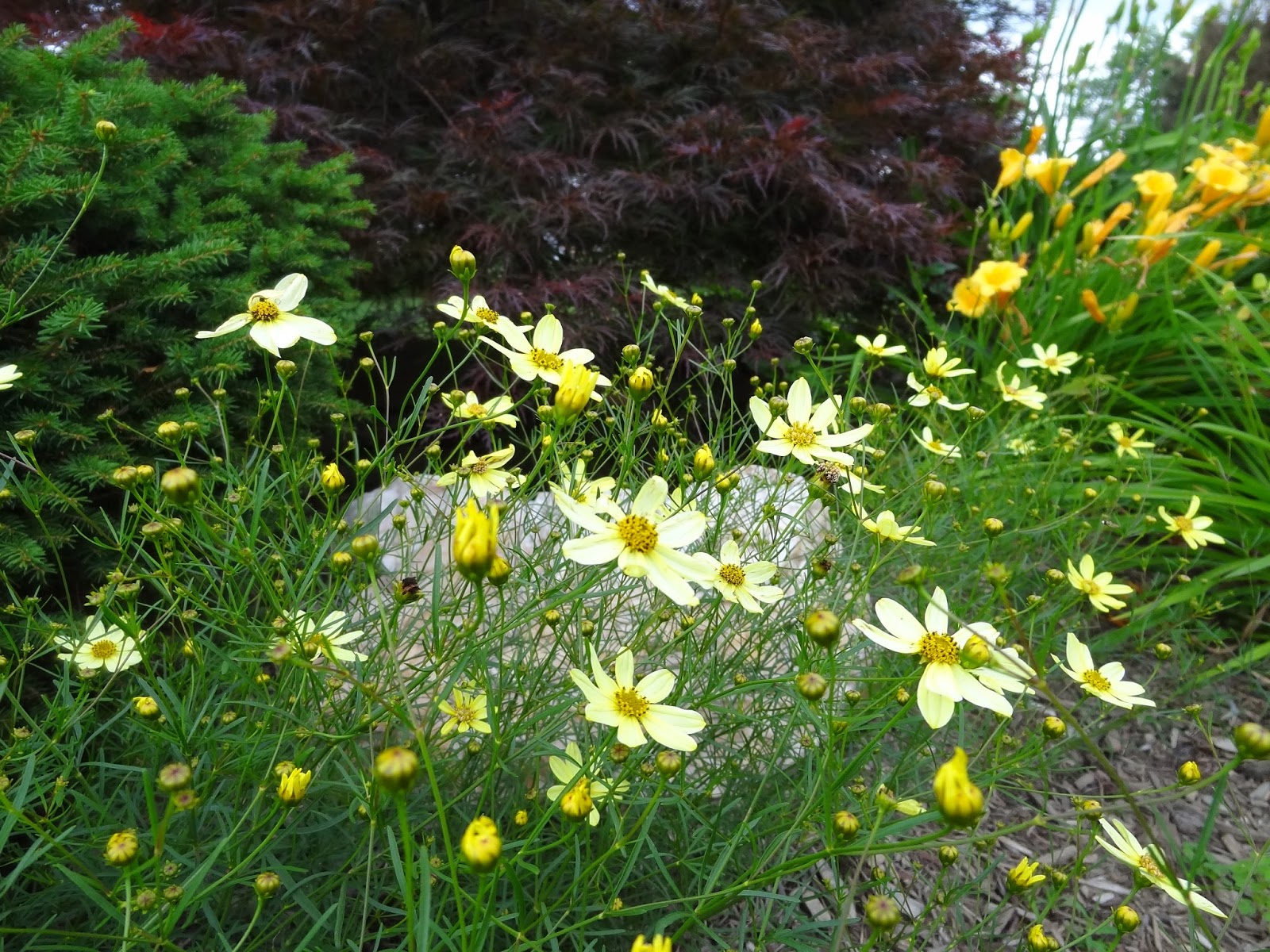
Coreopsis


Tuesday, June 28, 2016

The Mountain State

Since this is the third day in a row that I'm writing about the floods in West Virginia, you can tell that they have been on my mind a lot. Today, I'm going to explain a little bit about the topography of West Virginia and how it affects the flooding. This may help with some of the confusion about what is going on.

WV Hills, A stop on the way to visit my mother last Thanksgiving

One of West Virginia's nicknames is The Mountain State. It was also called Little Switzerland by the early settlers. This was because almost the entire state is filled with hills and mountains. In the eastern part of the state are the long ridges and valleys of the Appalachian Mountains and in the western part of the state are hills and valleys (hollows/hollers) from erosional relief on the Appalachian Plateau. What that means is that you are usually on top of a hill or in a narrow valley. There is not much in between.

An example of this was when they were going to build a new high school in my county, there was only one site that had enough flat land to build the school. Like I said, it's called the Mountain State for a reason.

So when there is rain, there is no where for it to go except to be channeled between the hills. And when there is a lot of rain in a short amount of time, it is more than the little streams and valleys can handle so there is a flash flood.

The football field of my high school. Notice the goal posts.
I had an experience with a flash flood once that made a big impression on me. One afternoon we were having a picnic at my grandmother's house.  Her house was built on the flood plain (flat spot) along a little creek surrounded by hills. The creek was not more than a few feet across in some places and was dry in some places. Well a summer afternoon thunderstorm sprung up and we scrambled to get everything put away and out of the rain. In the 10 to 15 minutes we were cleaning up, the little creek overflowed with fast, roaring water onto the road and we almost didn't make it out. It was scary and amazing at the same time. I truly understood what a flash flood was after that.

Flash flooding is what has been happening recently over much of West Virginia as most little streams and rivers have been overwhelmed by the large amount of rain there was over a short amount of time. While some areas were hit worse than others, most of the state and its ubiquitous small streams flooded. That's why 44/55 counties were declared disaster areas.

There is my very simplistic view of what's been going on, but I hope it makes sense and clears up a little of the confusion that is not being helped by the media.

It's raining in my hometown right now. I hope there is not more flooding to come.


Monday, June 27, 2016

Is that Right?

Devastating floods have put West Virginia in the news recently, and because I'm from the area, I've been noticing mistakes in the reporting. One source said that 44/54 counties had been declared disaster areas. Well, West Virginia has 55 counties. Another report at one point said that 98% of the state was without electricity. Well, one of the nearby towns to my mother had a 98% outage, not the whole state. Also, there were two places where the flooding was most severe--one on the east side of the state and the other on the west side of the state. The two areas were mixed up sometimes when reporting was done about damages. And of course, place names were said and spelled incorrectly.

Murray Gell-Mann - World Economic Forum Annual Meeting 2012.jpg
Nobel prize winng physicist
Murray Gell-Mann.--
Crichton said that he named the
 amnesia effect after him because
Gell-Man was a famous, well
respected man that would give
the idea some attention. 
These inconsistencies bring up an interesting subject in how we read the news that has been named The Murray Gell-Man Amnesia Effect. Michael Crichton coined the phrase after he spent an afternoon with physicist, Murray Gell-Mann. They were reading the newspaper and realized that when they read an article about something they knew about, they found all kinds of mistakes. But when they read an article about something they were unfamiliar with, they took the story at face value even though they knew that there were problems with other articles.

On the surface this doesn't make sense. Logically, if you know the reporting is inaccurate in one story, you shouldn't trust any other stories from that source. But that is usually not what we do. We seem to have an amnesia about the mistakes and take the other stories at face value.

I'd like to say that I am a critical consumer of news and don't trust anything I hear or read. But that wouldn't be true. I do listen with a bit of skepticism to some things, but most things I don't. Flooding in North Dakota. Never gave the accuracy of the reporting a second thought. An election in California. Ditto. And so it goes.

Have you ever thought about what reporting you accept as the truth and what you don't?


Sunday, June 26, 2016

Thankful Sunday--June 26, 2016


source

I am thankful for safe havens.

As you may know, West Virginia has been suffering from torrential rains and flash floods over the last couple of days. Twenty-six people have died. Forty-four counties have been declared disaster areas.

My Facebook page has been filled with pictures from friends with washed out roads and washed away houses. One friend was desperate to get to his injured mother who had to wait all night in an ambulance because of flooded and washed out roads. Another was praying for the survival of a friend who was washed down a storm drain. It has been difficult to see the devastation to areas that are so familiar to me.

However, amongst all of the chaos, I am thankful that my mother has been in safe haven. The facility where she lives is on top of a hill and remains high and dry. Also, staff have been able to make it to work to help with those who need daily care. So while I am praying for all who suffer from these devastating floods, I am thankful that my mother is in safe haven.