Thursday, April 30, 2026

Z is for


April marks the 15th anniversary of my blog, so during the A-Z blogging challenge, I will be sharing previous posts from over 2,100 I have written.

Over the past year or so, I have been writing book reviews here. They usually feature brief summaries and opinions of four books at a time. Before that, I would occasionally review just one book during a post. This book review post originally appeared in May 2013.

*****************************

Zero--a book review

This month's selection for my book club was Zero: The Biography of a Dangerous Idea by Charles Seife. This is a nonfiction book that discusses the history of numbers and their place in society, focusing on the ever-important concept of zero and its partner infinity. Now, if you're not a math person, don't stop reading yet. Seife has a master's degree in math and journalism and takes a seemingly dry subject and makes it a very interesting read. He starts in the beginning with the use of numbers to count things and goes to the present day with string theory and such. 

First, let me tell you what background knowledge I brought to the book, so you can put my perceptions in context. I had the basic science and math courses in college, including physics, chemistry, and calculus. I didn't have any advanced courses in these areas. However, I am married to someone who reads math and physics books for fun, so if you can learn anything by osmosis, I should know a lot. I found the book an interesting read for several reasons.

I had never thought about the evolution of numbers and their use. I guess I just assumed that all of them had always been there, including zero. However, that was naive. They have evolved over time just as our scientific ideas have often hand in hand--which makes perfect sense if I'd ever taken time to think about it. Also, I had never thought about the beautiful or sinister (depending on your point of view) concepts of zero and infinity in a religious sense. There have been a lot of differing ideas of whether God created things from something or from nothing, and whether there is a beginning and an ending to the universe. Many men and societies survived or didn't, depending on their views on this subject and what was politically correct at the time. Also, the book reads like a who's who of the big players throughout time in the science and math world. However, Seife does more than discuss their math contributions. He tells about the life they were living and how their work affected their life. It is very much a history book in all of these ways.

Zero is also a math book. As Seife describes each new concept as it was discovered, he gives very understandable examples of that concept in everyday terms. He seems to have a real gift for this, and I think his examples could be used in the classroom to make things clear and relevant to students.

Now, after all of that praise, let me tell you the rest of the story. The book can be a quick and easy read. At least that was how it was for the math professor in our group. However, I found it a fast read if I didn't try to completely understand the examples or a tedious read when I was trying to understand them--especially toward the end when they were getting more complex.

What did the others think about Zero? Some commented that there may have been other sides to the story, especially in the religious context, than were presented by Seife. However, most of the other comments were favorable. They thought it was well written and the subject matter interesting. Out in the rest of the world, it has won awards and has gotten favorable reviews from most of the major newspapers.

Would I recommend the book? Yes, but I wouldn't call it a beach-read type book for the average person. I plan to read it again and savor all of the fascinating information it has to offer. (Especially when I have trouble sleeping.)

But wait, there's more:
In the latter parts of the book, it talks about many things that I have heard referenced on The Big Bang Theory. I now understand better what Sheldon and Leonard are often talking about.

But wait, there's even more:
If you want to know more details about the book, read here.
**********************************************
Until next time...


Wednesday, April 29, 2026

Y is for You All


April marks the 15th anniversary of my blog, so during the A-Z blogging challenge, I will be sharing previous posts from over 2,100 I have written.

Below is a post describing the summer when I learned a little about the way I talk that I hadn't realized. This was an A-Z post in 2015.

*******************************************************

Y is for You All


I grew up in West Virginia, where there seemed to be a dividing line between the way people talked. To the north, people spoke more with a Midwestern/northern accent, and to the south, there was more of a southern accent. I actually saw a map once that showed this dividing line. From my experience, it made a lot of sense.

If you went one county north of me, you would hear a more Midwestern sound. Go one county south of me, and you would hear more of a country, southern sound. These variations also happened between towns to the more rural areas. I was a town kid living more to the north, so I didn't have much of an accent. Well, we all have an accent one way or another, but I sounded more like a news anchor than Ellie Mae Clampett. People have often been surprised when I tell them that I'm from WV. They think I should have much more of a southern drawl.

That was until I spent one summer in northern Wisconsin and the Upper Peninsula of Michigan. I had just graduated from college, and before heading off to grad school, I was doing a summer of field work for the USGS (United States Geological Survey) there. After spending the day in swampy muck with almost unbearable numbers of mosquitoes, we spent the evening at the bar in the local fishing "resort" where we were staying. We made fast friends with the owners and several of the locals who hung out there.

One evening, Gary, one of the owner's sons, said that I had a very southern accent. He said, "You talk like this," with very drawn-out, twangy words. Very southern. He also said that I said, "You all." Well, I guess I did sound kind of southern to someone who lived much further north than I did. But I had never noticed that I said you all. I learned in English class that you could be both singular and plural, and that's the way I wrote it. I thought I talked that way also. I knew I didn't say the southern contraction Y'all, but I hadn't realized that I said a form of it.

That summer, I tried to stop saying you all and use you for both singular and plural, like I thought I was already doing. And I couldn't do it. If a group of people were standing around and I said, "Do you want to go to the movies?" I would wait for a minute and then had to add all so my meaning was clear, "Do you all want to go to the movies?" Without the all, I was afraid that they wouldn't understand that I was inviting all of them. That's when I figured out that in my world you is singular and you all is plural.

And that's how it's been ever since. Just like it was before. You is singular, and you all is plural.

What do you say? You, you all, y'all, youins, ...

*******************************

Until next time...


Tuesday, April 28, 2026

X is for Xeriscape


April marks the 15th anniversary of my blog, so during the A-Z blogging challenge, I will be sharing previous posts from over 2,100 I have written.

I didn't have much to choose from for the letter X from previous years. Here's one on xeriscaping that I did for the letter X during the A-Z Challenge in April 2021. Just in case you're not familiar with the term, xeriscaping is a gardening method that conserves water.

*************************

X is for Xeriscape Vegetable Gardening

Fig trees like dry feet, so they would be good for xericaping.
(I know. Figs are a fruit, not a vegetable.)

 If someone had asked me if xeriscaping was compatible with vegetable gardening, I would have said no, at least not for the vegetables I'm familiar with. I would have been wrong. There are some vegetables that will do okay without lots of water. With a bit of poking around, I found information that will be useful to me while gardening here, even though, on paper, we have adequate rainfall. The problem is it's all an average, and we usually have a long dry spell at some point in the summer. Here are a few tips I learned about growing vegetables without much water.

Miss Lander's oregano
--There are many herbs that do well in dry conditions. Oregano, thyme, rosemary, marjoram, and lavender are some of them. Currently, I am not growing any herbs, but I have had good luck with oregano, rosemary, and lavender in the past. They thrived in the "plant and forget" environment I provided for them.

--Plant vegetables that mature quickly, so they will be ready before the long dry part of summer arrives. Good ones for this are radishes, broccoli, cauliflower, leaf lettuce, and beets. I have all of these growing now. I got them in earlier than last year, so maybe I will have a better yield before the warmer, drier weather sets in.

Miss Lander's sweet potatoes
--Okra, sweet potatoes, and muskmelon do well in drought. I won't be growing any of these since they're not my favorite.

 --Raised beds and/or well-tilled soil allow roots to grow deeper, so the plant will be less affected by no rain. We put in raised beds last year and tilled the soil below them before we filled them. The soil in them is a big improvement over the native rocky soil.

 --Mulching is a good way to retain moisture. We mostly use straw for this, and we have some leftover from last year.

 --Legumes do not need as much water as many vegetables. We're growing peas now, but not sure we will have room for any of the warmer weather ones. 

--Install a rain barrel to collect water to use later. Ward installed a rain barrel last year for my birthday. It has been very handy this spring for watering the new plants.

So how about that? I am already doing some of the things recommended for xeriscape gardening. I was just doing them to make things easier.

How much rainfall do you have where you live? What do you do about watering plants?

Sources:

https://www.gardeningknowhow.com/special/xeriscape/integrating-vegetables-and-herbs-into-the-xeriscape-garden.htm

https://www.rainharvest.com/blog/?p=474

https://en.wikipedia.org/wiki/Xeriscaping#:~:text=Xeriscaping%20is%20the%20process%20of,eliminates%20the%20need%20for%20irrigation.&text=In%20some%20areas%2C%20terms%20such,smart%20scaping%20are%20used%20instead.

*******************************

Until next time...


Monday, April 27, 2026

W is for Wally Makes Soup

  April marks the 15th anniversary of my blog, so during the A-Z blogging challenge, I will be sharing previous posts from over 2,000 I have written.

I'm not into cooking, so recipes or food discussions are not a common feature on my blog. However, I do publish a recipe from time to time. Here is a post about a potato and ham soup that Wally made. This was originally published in March 2012.

********************************

Wally Makes Soup
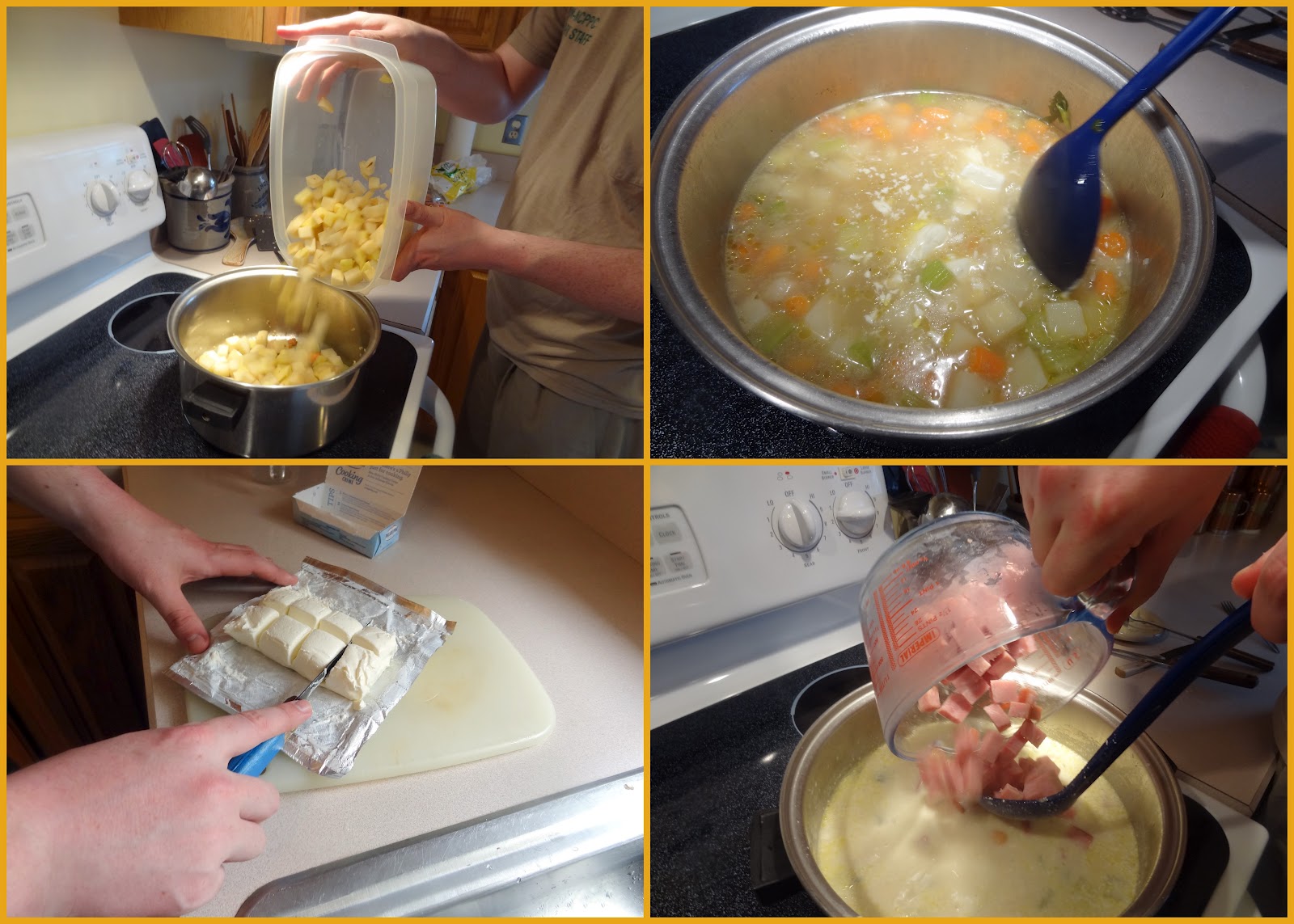
Wally likes to eat. No, let me correct that. Wally loves to eat. However, he doesn't like to cook. But today, he did just that. I asked him to help me with some potato soup by peeling the potatoes. One thing led to another, and in less than an hour, he had created a delicious potato ham soup.

True to the family tradition, he didn't follow a recipe. He looked at a couple of recipes, took inventory of ingredients on hand, and started cooking. For better nutrition, he added carrots and used low-fat cream cheese. He didn't use onions as a favor to Ward, and he added his own special optional ingredient at the end--Stubb's Spicy BBQ Sauce. The result was a very delicious soup that reminded me of scalloped potatoes with ham. I hope this successful cooking adventure is the beginning of a new trend.

Below are basic instructions for making the soup. Detailed recipe at the end.


Chop potatoes, celery, carrots, and ham.


Sauté celery, carrots, and garlic, then add potatoes and water. Cook until veggies are tender. Add cream cheese and ham.                                     


Garnish with cheddar cheese and/or Stubb's Spicy BBQ sauce. Serve and enjoy!


Wally's Potato Ham Soup

Ingredients:

Oil, 1 T
Celery, 2 stalks chopped
Carrots, 3 large chopped
Garlic, 3 cloves minced
Potatoes, 7 medium--5-6 cups chopped

Water, 4 ½ cups
Chicken bouillon cubes, 2

Low-fat cream cheese, 8 oz, softened and cut into 1 1/2 inch cubes
Ham, 2 cups chopped (¾ lb)

For garnish:
Shredded cheddar cheese
Stubb's BBQ Sauce, 1 teaspoon/bowl

Sauté celery, carrots, and garlic in oil until celery starts to soften.

Add potatoes, water, and bouillon cubes. Bring to a boil and boil until vegetables are tender. Approximately 10- 15 minutes.

Lower heat or turn off heat on electric range and add cream cheese. Stir until melted.

Stir in ham.

Note: I added a little of Stubb's spicy BBQ sauce into my bowl. It gave the soup just a hint of spicy hotness without overwhelming the other flavors.

My mom and dad just put a little shredded cheese on theirs.

Everyone was happy. I hope you like it too.
*********************************

Until next time...


Saturday, April 25, 2026

V is for Velleity


April marks the 15th anniversary of my blog, so during the A-Z blogging challenge, I will be sharing previous posts from over 2,100 I have written.

Here is another repost from an A-Z Challenge in 2015. I could add a lot more to the list if I were writing this today. 😀

************

V is for Velleity

You know how they say if you are really going to learn a new word, you need to use it. Well, a couple of years ago, I learned velleity, a new-to-me word that I thought was great. I could see using it on a daily basis. However, that never seemed to happen after the first week, and I forgot it until recently. So I'm going to take a stab at it again.
____________________________________________________

Velleity 

Velleity---a noun that means to have a wish or desire to do something, but you are not interested in it enough to act on it.

--My desire to revamp the look of my blog was more of a velleity than a real plan.

--Velleity is what keeps me from cleaning up the pile on the bed in the guest room.

Can you think of a way you could use velleity in a sentence?

But wait, there's more.
Here's how you say velleity.
***************

Until next time...


Friday, April 24, 2026

U is for Use it Up


April marks the 15th anniversary of my blog, so during the A-Z blogging challenge, I will be sharing previous posts from over 2,100 I have written.

I did the post below for the 2022 A-Z Challenge. I had forgotten the details of it, so maybe you have, too. Here it is.

***************************************************


This is a cross-stitch that I did several years ago. I selected it because I liked the saying and the flower detail around the edges. Recently, I began to wonder about the origin of the saying. After a bit of Googling, Barry Popik, who studies the origins of words, enlightened me.

The saying is thought to be a New England proverb seen in print as early as 1933. Earlier versions of the saying were “Eat it up, wear it out, make it do,” and it was widely used during the Great Depression. However, the War Advertising Council modified it and used the saying during World War II to promote the conservation of resources to help the war effort. During this campaign, the wording was changed to "Use it up, wear it out, Make it do, Do without." 

It has been used since then by frugal and environmentally-minded people everywhere. Do you ever quote this saying?
********************************
Until next time...


Thursday, April 23, 2026

T is for Today


April marks the 15th anniversary of my blog, so during the A-Z blogging challenge, I will be sharing previous posts from over 2,100 I have written.

Through the years, I have occasionally written a Today post. In these posts, I have a picture I have taken, along with reminders of ways I want to live my life better. I liked looking back through these, and I think I should make it a practice again. Below are a few of my Today posts.

************************

Today, I am going to think about the things outside of me that are gradually affecting my life.


This is part of Wally and Theodore's tree house that Ward built years ago. As you can see, the tree is slowly growing around one of the supports and has pushed up a floorboard. I need to think about whether or not I have a "tree" slowly changing me. Am I letting outside forces determine where I'm going and where I'm going to end up? I'm not sure, but I do know that if I don't think about it, they very well might.

____________________________________


Today I am going to be organized
 and not run around in circles.


Some days are more productive than others, and it usually involves being organized and having a plan. I have a plan, so I am not going to get dizzy trying to get things done today.

_____________________________

Today I am going to stand out from the background.


Six-spotted Green Tiger Beetle


Some days it is easier to just go with the flow, but today I am going to put forth the extra effort to stand out from my status quo. I'm going to do that by trying something out of my comfort zone. So many things to choose from...

__________________________________________

Today I am going to step back and look at things from a distance.


Sometimes I get too caught up in the details and forget the big picture. Today, I am going to look from a distance so I can get a new perspective on things.

******************************

Until next time...


Wednesday, April 22, 2026

S is for a Second Look


April marks the 15th anniversary of my blog, so during the A-Z blogging challenge, I will be sharing previous posts from over 2,100 I have written.

I faithfully did Second Look posts every week for years. During this time, I would take a look around my yard and record what I saw. We had 2 acres with many established beds and some wild areas. I loved exploring every week and learned so much about bugs, plants, and animals that visited our yard. I tried continuing the practice when I moved here, but our yard is smaller and tamer than before, so I didn't keep it up. Maybe I should try again.

Below is the post that started it all. This was written in April 2011 and was the second post I ever wrote.

*************************************************

A Second Look


Spring has sprung!  The flowers are emerging from the ground. The pollen is dropping from trees. Plentiful April showers are determined to bring May flowers.

Spring was an enchanted time for my children when we first moved to the four-season climate that we live in now. Up until this point in their lives, they had lived along the Gulf Coast, where the seasons were marked by whether or not you wore a light jacket or were drenched in sweat. The emergence of the crocus, the blooming of the daffodils, and the sprouting of new green leaves were things they had never seen before.  When they came home from school, they would call me out into the yard, and we would go on a treasure hunt to find what new flowers were blooming. It was an exciting time for all as we got to know our new surroundings. This excitement lasted all summer that first year. 

Then, as time wore on and the weeds seemed to be encroaching menacingly on our beautiful flowers, our emphasis changed. We began to notice the weeds more than the flowers. The kids got more interested in video games than plants, and the names that I taught them of the colorful blooming flora in the beginning became the yellow one and the purple one. In other words, our enchantment was gone. Spring moved into the background as all things seem to do after a while.

Then this Spring, we had a taste of that excitement again. While cutting daffodils to bring inside, we discovered that instead of just some white ones and some yellow ones, we actually had 6 different varieties. Who knew? With the second look at the daffodils, we noticed other things growing around them. We noticed which ones bloomed early and which ones were just budding. We noticed which plants the deer had been nibbling on. We noticed the birds. Wow! There's a lot of activity going on outside this time of year if you take the time to notice.

It may not last long, but for just a little while, we were all like the young kids my sons were that first year. I hope we can remember to take a second look at things around us, then and again. Who knows what we'll find?
******************************


But Wait There's More!
A Second Look around my yard at what's new.

First up is the rainbow we saw. Ward said that he thought it was a double rainbow. I didn't see a double one.

The azaleas have bloomed. If you look closely at the next pictures,
 you can see I took them just after it stopped raining.

Azalea

Amsonia

Cherry laural

Lily of the Valley

Iris

Dogwood

Azaleas

Chickadee nest. No eggs yet.

Weather vane on top of our garage.
 Bless asked for a picture, and I finally remembered to take one.

Until next time...


Tuesday, April 21, 2026

R is for Reasonings


April marks the 15th anniversary of my blog, so during the A-Z blogging challenge, I will be sharing previous posts from over 2,100 I have written.

Over the years, I have shared stories about Wally and Theo when they were young. I found a series of posts I did called The Reasonings of Wally. Below are a couple of them from 2012 and 2013.
***********************************************
This happened when Wally was four years old.

Ward and I came home from work and went upstairs with Theo. He sat quietly on the floor, looking at a book, while we changed our clothes and discussed how our days had gone. Soon we went downstairs to join Wally, who was watching Sesame Street. Theo toddled in front of us, and when he reached the kitchen floor, his feet slid out from under him, and I heard a loud crack as his head hit the floor. That was soon followed by loud crying. As I went to see if he was hurt, I slipped too, but fortunately didn't go all the way down. We both had slipped on a wet floor, and luckily, Theo was not badly hurt.

As it turns out, Wally was no longer watching Sesame Street. He was standing in the middle of the family room (next to the kitchen) with the garden hose in his hand, spewing water everywhere. At that point, Ward and I just about lost it. Trying to get control of the situation, I immediately sent Wally to his room and told him to get on his bed and not move until we came to talk to him. Next, while Ward took the hose outside and turned off the water, I dried off Theo and put him in his high chair to keep him out of the way. And then we began the long task of trying to clean up the water. There was about 1/4" of water on the tile floors, and the carpets next to them were soaked. The whole drying process actually took days, but after an hour or so, we had most of the water sopped up.

Then, to deal with Wally. We still found him on his bed. He knew that we were not happy and was afraid to move. After a few sentences about the danger of wet floors and the problems that come with wet carpets, we asked the question we had been wondering about the most.

"Wally, what were you thinking?"
He slowly replied. "Well, my good mind was on vacation in Alaska, and my bad mind said, 'Do it, do it. It will be fun.'"

And there you have it. The reasoning of a four-year-old Wally.

Note: Recently, I was recounting this story to a friend, and she wondered how Wally got the hose if the doors were locked. I just laughed because both of my kids were escape artists.
******************************

Reasonings of Wally

or The Logic of the Young


A conversation with a young Wally
.


"Wally, I see you were eating ice cream again without asking first. This has been happening too much lately. I am worried about your lack of willpower."

"Mama, my willpower is usually very good. Except when I get caught."

***********************************************************
Until next time...