Friday, July 26, 2013

Food Waste Friday and True Food Confessions--July 26, 2013

It's time for Food Waste Friday, when the Frugalgirl encourages us to post pictures from the previous week of wasted food from our household. This accountability hopefully will help us to be more careful with our food and maybe save some money. Also, I am using this public forum to encourage us to eat out less which includes better meal planning. You can follow how we are doing in this endeavor by reading True Food Confessions.

This Week's Food Waste 
NONE
  Hooray! 


This Week's True Food Confessions 
  

This week was more organized than last week, so we only ate out once. I think we were more successful  because we had something to focus us--produce from Uncle Billy's garden. We used the new potatoes to make a hearty soup with the roast we had last week and other fresh vegetables to make sandwiches. We were eating blueberries by the handful and every morning for breakfast. Also, we had a spinach pie one night and another night we had a tuna and squash casserole that was very good. This was a good way to use squash and tomatoes that we had and I've included the recipe. You can play with this recipe many ways, but here's how I made it. I think the fresh tomato on the top sets it apart from the standard tuna casserole. It was a hit with everyone here and you may enjoy it at your house.

Tuna Squash Casserole

--2 6 oz. cans of tuna drained
--2 medium size squash--one crook neck, one zucchini
--6 oz. of dry egg noodles cooked according to package directions
--1/2 cup no fat Greek yogurt
--1/2 low fat mayonnaise
--1/2 teaspoon ground thyme
--1 cup shredded cheddar cheese
--1 tomato chopped

--Preheat oven to 350° F 

--Cut squashes in 1/2 inch pieces and cook until tender-firm. (That took me about 5 minutes in the microwave.)

--Mix yogurt, mayonnaise, tuna, thyme, and 3/4 cup cheese together in a large bowl.   Add noodles and put into casserole dish. 

--Bake covered for about 30 minutes or until you just start to see bubbling around the edges.

--Take out of oven and add the remaining 1/4 cup of cheese and tomato on top of that.

--Bake another 10-15 minutes.

--Enjoy

Until next time...


Wednesday, July 24, 2013

A Second Look--July 24, 2013

As I sat down to write this post, I just saw a fox trot across the yard. That is a somewhat unusual occurrence for daytime and it got all of the cats on alert. I'm glad there is a window between them.

The days continue to be warm and humid with an occasional thunderstorm. On my way inside one day as one of these storms began, I discovered both tussock moth caterpillars and monarch butterfly caterpillars on the milkweed. I hope that we will eventually see a monarch emerge from a cocoon, but it's not looking too promising right now. Despite our best efforts, the tussocks outnumber the monarchs 100/1. Also, there have been two more eggs added to the sparrows nest and the mama is sitting on them. The day lilies and tiger lilies continue to bloom as well as the marigolds and daisies. (And the beetles continue to feast on them.) Many butterflies are fluttering by-especially around the tiger lilies. It's a beautiful time of year.

Here are a few of the things I saw this week during a Second Look.

Day lily


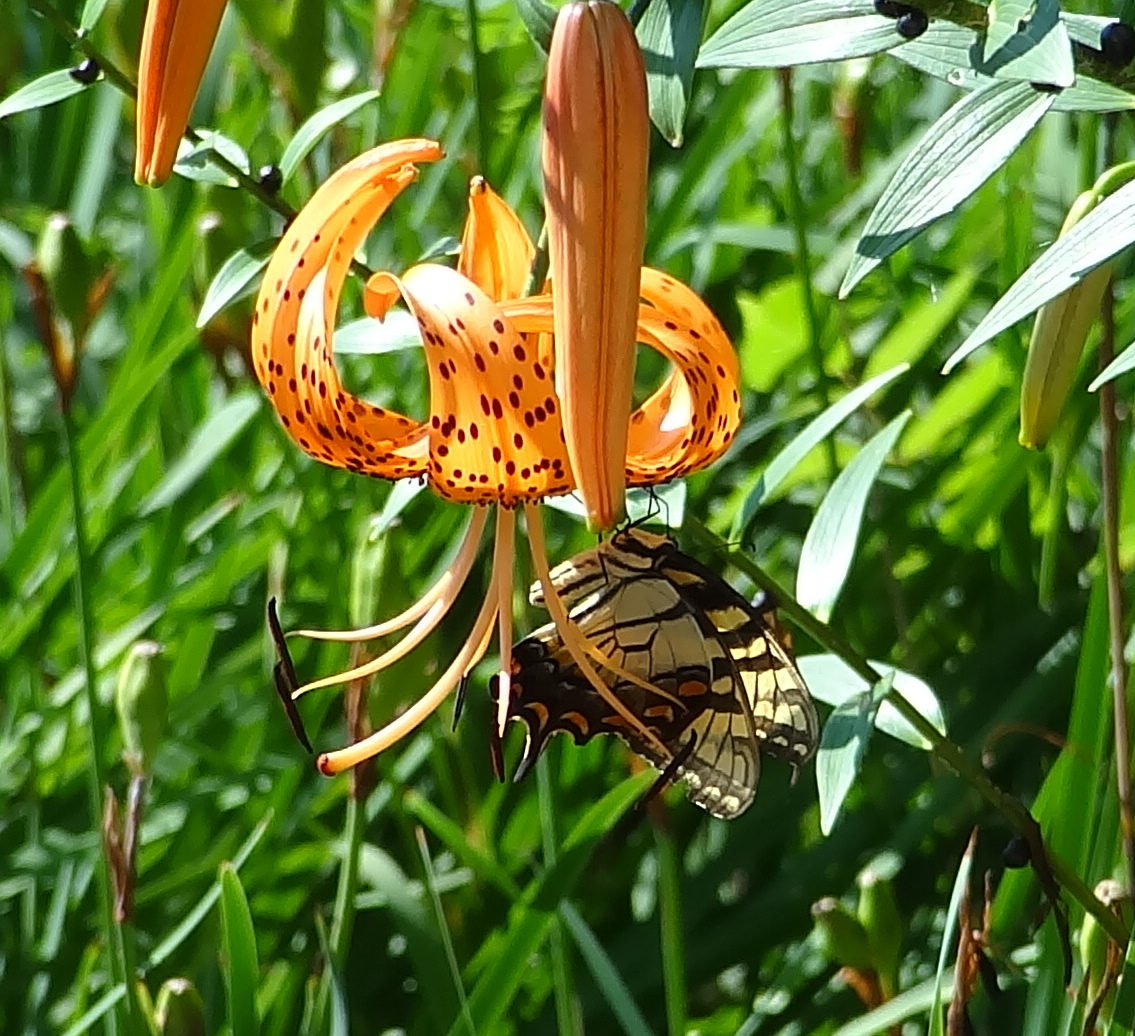
Black swallowtail on tiger lily


Hibiscus buds


Tiger swallowtail on tiger lily


Marigolds


Day lily


Left: Monarch caterpillar eating from behind. Right: Tussock caterpillars eating, eating, eating.


Sparrow's nest. Two eggs and more feathers have been added since last week.


Tuesday, July 23, 2013

Today...

Today I am going to stand out from the background.


Six-spotted Green Tiger Beetle

Some days it is easier to just go with the flow, but today I am going to put forth the extra effort to standout from my normal status quo. I'm going to do that by trying something out of my comfort zone. So many things to choose from.


Monday, July 22, 2013

Caterpillar Wars

For several years now, I have had milkweed growing in one of my flower beds. This is the host plant for monarch butterflies, so it is often recommended as a native plant for your yard. Even though it grew like a weed and was sometimes unsightly in my planned bed, I left it alone. However after watching it for several years and never seeing any sign of monarchs, I pulled it out. But it came back.(Did I mention the growing like a weed part?) This year, it has been particularly vigorous and was starting to takeover, so I decided that I was going to try to pull it out again or at least try to replant it in a more desirable area. However, when I checked it again this weekend, I found it covered with orange and black fuzzy caterpillars. Upon further investigation, I learned that they were tussock moth caterpillars. There were several descriptions of them, but all included the fact that they are voracious eaters. Maybe this was the natural way that I was going to get rid of the milkweed.

I took Ward out to show him these colorful worms and they had already stripped leaves from several plants and were hungrily working on more. And do know what we saw among them? A monarch butterfly caterpillar! There was no way this one monarch* was going to compete, so we set out to remove as many of the tussocks as we could. The spines on the tussock caterpillars can sting, so we used gloves, a stick, and teamwork to try to rid the milkweed of these hungry eaters. During this tedious process, we found another monarch caterpillar. Wow, two in one year! Now, it is a watching and waiting game to see what develops--monarch butterflies and/or tussocks moths. I know what I'm hoping for.

In addition to being a host plant for butterflies and moths, bees like  milkweed's late spring blossoms. This is when the eggs were probably being laid.


Milkweed Tussock Caterpillars devouring a leaf.


After stripping the leaves from this plant, the tussocks moved onto the next one.


The two monarch butterfly caterpillars we found. Notice the one of the left has eaten away half of the leaf.


If we knew much about monarchs, we would have realized that this skeleton leaf pattern that we saw earlier is common for young monarch caterpillars. At this stage, they don't eat the entire leaf like above.

*Monarchs often only lay one egg per plant to make sure the growing larva has plenty to eat.


Sunday, July 21, 2013

Thankful Sunday--July 21, 2013

I am thankful for thunderstorms.


The view out our window during the storm last night.

Last night, we had a thunderstorm--the kind that happens at the end of a hot humid day. We turned out the lights and watched the show outside, and today we are thankful for the cooler weather it brought.

(When I see a storm, it often reminds me of Theo and his observations about them when he was little.)