Wednesday, July 24, 2013

A Second Look--July 24, 2013

As I sat down to write this post, I just saw a fox trot across the yard. That is a somewhat unusual occurrence for daytime and it got all of the cats on alert. I'm glad there is a window between them.

The days continue to be warm and humid with an occasional thunderstorm. On my way inside one day as one of these storms began, I discovered both tussock moth caterpillars and monarch butterfly caterpillars on the milkweed. I hope that we will eventually see a monarch emerge from a cocoon, but it's not looking too promising right now. Despite our best efforts, the tussocks outnumber the monarchs 100/1. Also, there have been two more eggs added to the sparrows nest and the mama is sitting on them. The day lilies and tiger lilies continue to bloom as well as the marigolds and daisies. (And the beetles continue to feast on them.) Many butterflies are fluttering by-especially around the tiger lilies. It's a beautiful time of year.

Here are a few of the things I saw this week during a Second Look.

Day lily


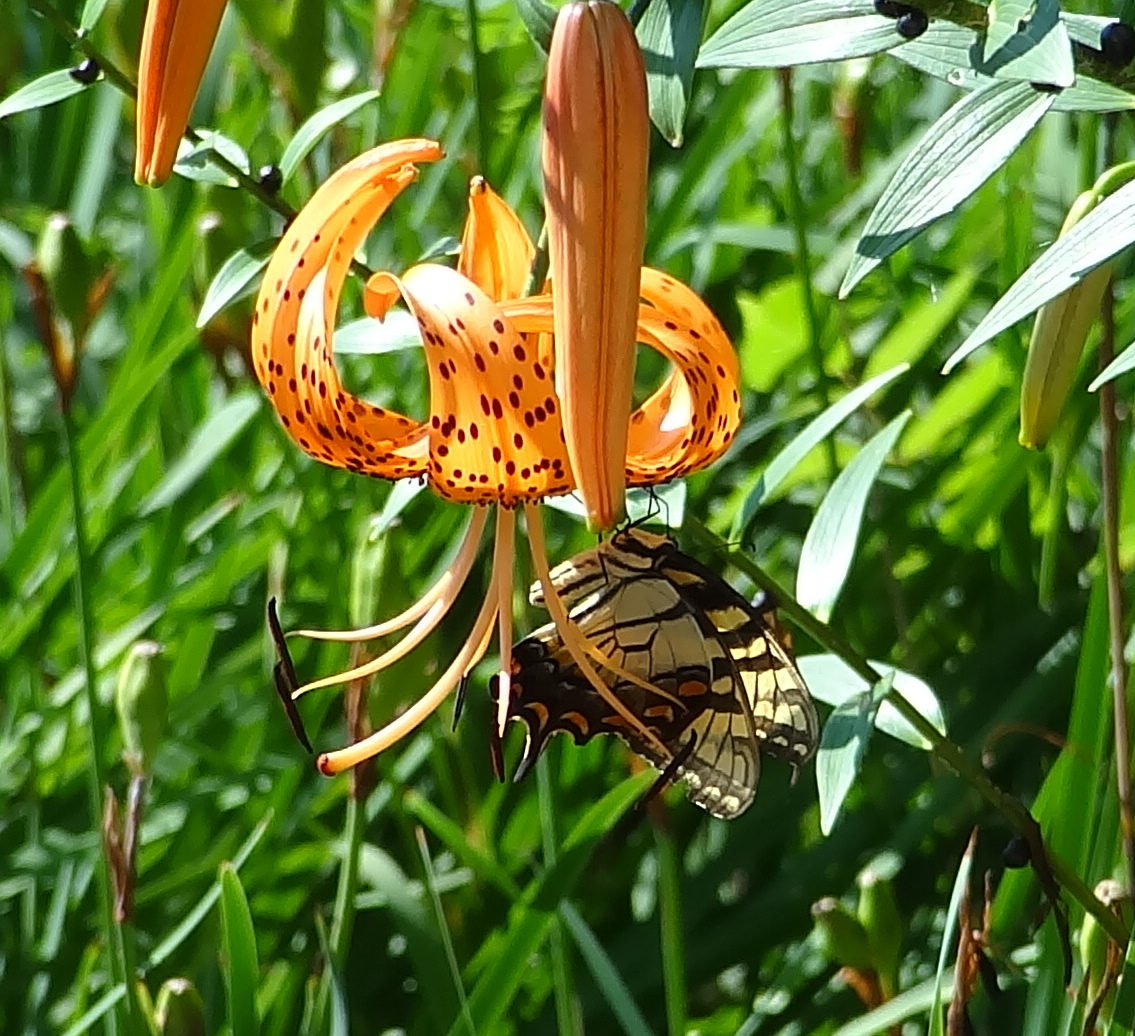
Black swallowtail on tiger lily


Hibiscus buds


Tiger swallowtail on tiger lily


Marigolds


Day lily


Left: Monarch caterpillar eating from behind. Right: Tussock caterpillars eating, eating, eating.


Sparrow's nest. Two eggs and more feathers have been added since last week.


Tuesday, July 23, 2013

Today...

Today I am going to stand out from the background.


Six-spotted Green Tiger Beetle

Some days it is easier to just go with the flow, but today I am going to put forth the extra effort to standout from my normal status quo. I'm going to do that by trying something out of my comfort zone. So many things to choose from.


Monday, July 22, 2013

Caterpillar Wars

For several years now, I have had milkweed growing in one of my flower beds. This is the host plant for monarch butterflies, so it is often recommended as a native plant for your yard. Even though it grew like a weed and was sometimes unsightly in my planned bed, I left it alone. However after watching it for several years and never seeing any sign of monarchs, I pulled it out. But it came back.(Did I mention the growing like a weed part?) This year, it has been particularly vigorous and was starting to takeover, so I decided that I was going to try to pull it out again or at least try to replant it in a more desirable area. However, when I checked it again this weekend, I found it covered with orange and black fuzzy caterpillars. Upon further investigation, I learned that they were tussock moth caterpillars. There were several descriptions of them, but all included the fact that they are voracious eaters. Maybe this was the natural way that I was going to get rid of the milkweed.

I took Ward out to show him these colorful worms and they had already stripped leaves from several plants and were hungrily working on more. And do know what we saw among them? A monarch butterfly caterpillar! There was no way this one monarch* was going to compete, so we set out to remove as many of the tussocks as we could. The spines on the tussock caterpillars can sting, so we used gloves, a stick, and teamwork to try to rid the milkweed of these hungry eaters. During this tedious process, we found another monarch caterpillar. Wow, two in one year! Now, it is a watching and waiting game to see what develops--monarch butterflies and/or tussocks moths. I know what I'm hoping for.

In addition to being a host plant for butterflies and moths, bees like  milkweed's late spring blossoms. This is when the eggs were probably being laid.


Milkweed Tussock Caterpillars devouring a leaf.


After stripping the leaves from this plant, the tussocks moved onto the next one.


The two monarch butterfly caterpillars we found. Notice the one of the left has eaten away half of the leaf.


If we knew much about monarchs, we would have realized that this skeleton leaf pattern that we saw earlier is common for young monarch caterpillars. At this stage, they don't eat the entire leaf like above.

*Monarchs often only lay one egg per plant to make sure the growing larva has plenty to eat.


Sunday, July 21, 2013

Thankful Sunday--July 21, 2013

I am thankful for thunderstorms.


The view out our window during the storm last night.

Last night, we had a thunderstorm--the kind that happens at the end of a hot humid day. We turned out the lights and watched the show outside, and today we are thankful for the cooler weather it brought.

(When I see a storm, it often reminds me of Theo and his observations about them when he was little.)


Saturday, July 20, 2013

The Good Earth--a book review


I've been meaning to read The Good Earth since I first heard about it in grade school. The author, Pearl S. Buck, was born in West Virginia and was part of my WV history lessons back then. This month I finally joined the other millions (billions?), who have read the book when I read it as part of my book club.

The Good Earth was published in 1931 and follows the life of Wang Lung in pre-revolutionary rural China. The book begins with a young Wang Lung preparing for his wedding day and follows his life until he is old and close to death. He values the land and farming above all else which leads him from humble beginnings to being a rich man. Along the way, we see him suffer through famines and personal hardships and watch the way his eventual wealth affects him and the next generation.

This book has been a classic since it came out. It won a Pulitzer Prize and also helped Buck win the Nobel Prize for Literature. (And if that weren't enough, it was chosen for Oprah's Book Club a couple of years ago). What all of this means is the book has been studied and talked about for decades now. Its historical significance and literary merits have been debated by many scholars as well as high school students. So there's a lot of information out there you can read for an in depth analysis of it. However, in the meantime I'm going to tell you what I thought about it when I read it as an afternoon pleasure read.

Buck's writing style is what impressed me the most about this novel. She writes in a simplistic way about profound events. It reminded me of Bible stories where powerful stories are told with just the simple facts. When I was describing this to Theo he said, “You mean she tells you the story, but doesn't tell you how to feel about it.” And I think that is a good description. But among this simple story telling are very rich details about Chinese culture which also play a major role in the plot. All in all, it is a very compelling read.

I thought the book could have ended sooner than it did. It seemed to me that the story plodded along a little longer than it needed to. However, another member of the club thought that Buck was slowing down the story just as Wang Lung's life did as he aged. In retrospect, this made a lot of sense to me. Maybe it ended at just the right time.

What did the other members of the club think? Everyone liked the book, including me, and it provided a good discussion. This is not always the case when everyone likes a book.

Recommendation: If you are one of the few like I was who have not read The Good Earth, give it a try. Unlike some classics, it is an easy, enjoyable read, but like many classics, it will give you much to reflect on.
_______________________________________________________________________________
But Wait, There's More:

--The Good Earth is the first book in a trilogy about this family. It is followed by Sons and a House Divided.

--I don't like to give away much of the story when I do a review, so I don't do that here. However, if you'd like to know more about The Good Earth, read here.