Saturday, March 3, 2012

Timber--Part Two

Ward is guest blogger for today.


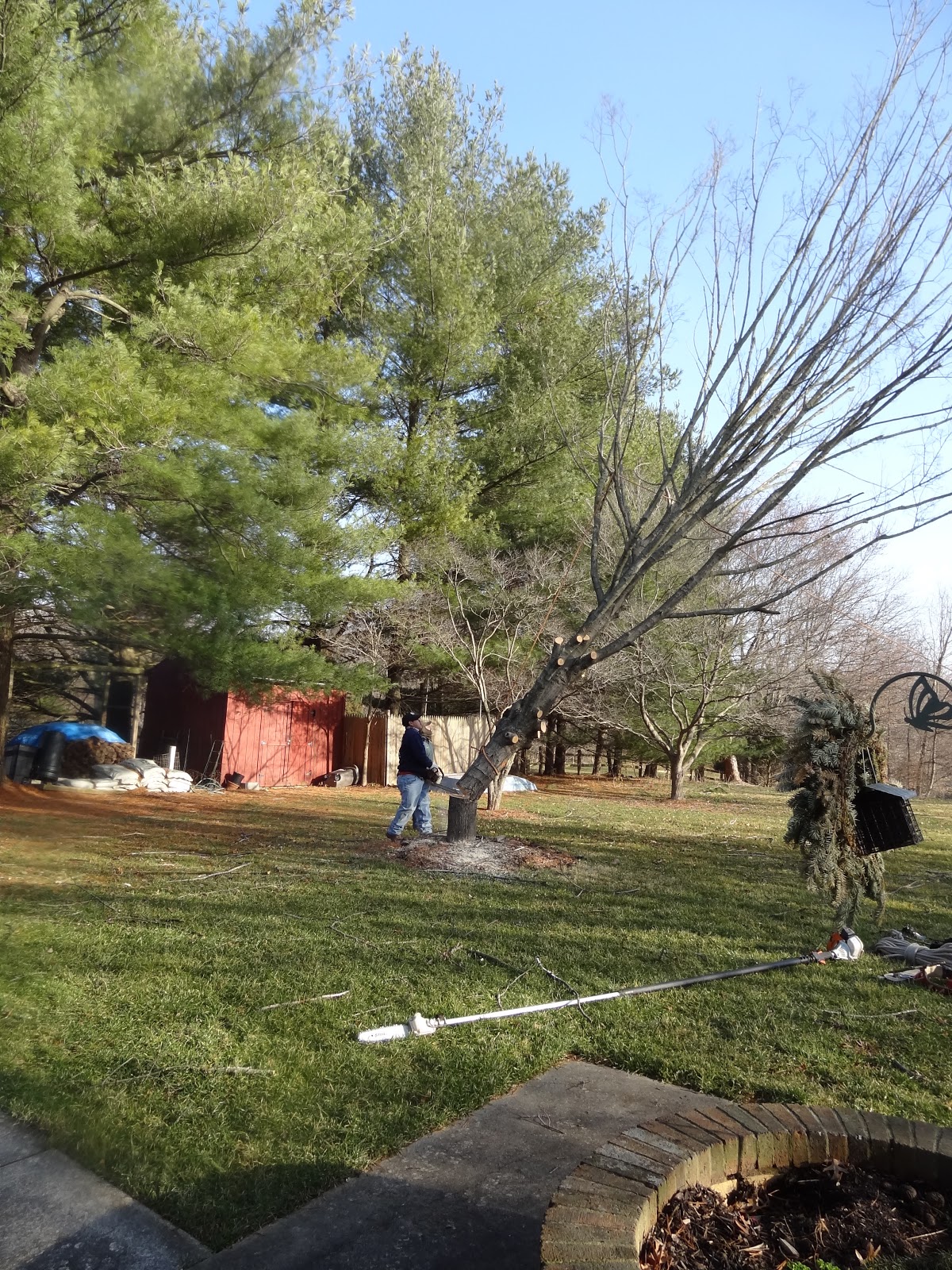
We recently had a diseased spruce and a diseased maple tree taken down. The tree company we hired came with a crew of nine and finished both trees in a little over an hour. They were impressive to watch. Below are highlights from their operations of taking down the maple tree. The spruce tree procedures were similar.

The maple tree had been killed by years of visits by sapsuckers. The sapsuckers would peck a ring of holes all around the trunk, about a quarter inch across, about half an inch apart. There were rings of holes all over the tree.
 
This was the telescoping pole chainsaw they used to cut the lower branches off the tree. It was about 12-14' long when extended. The blade was about 12" long.

This guy could whip the saw quite skillfully all over the place. As he worked his way around the tree, his coworkers would drag the branches away to the chipper.

Here is the chipper. It would take a long branch 15-20' in about 30 seconds. This was a very loud machine.


The tree was about 30' tall. They tied a rope to put tension away from the house, and used a big chain saw and cut the trunk. You can't see it here but he did cut a notch in the trunk on the side direction it was supposed to fall, and it did fall exactly where it was supposed to.


As soon as the tree was down, workers swarmed around the tree and started cutting and carrying away branches.


Others were working on the stump. The stump was about 12" in diameter and he cut it into pieces about 18" long. The chipper handled these large stump pieces easily. A little more heavy duty than the one in our shed.


While some were cutting and chipping, others were raking and carrying away small debris.


Once the stump was cut low to the ground, the man with the stump grinder started to grind the stump and roots. As you would expect, the spruce tree was much easier to grind than the maple.


They were a thorough crew. They even blew a little bit of saw dust from the pavement.


This was what was left when they were done.

Timber--Part One


Today we had a maple tree taken down that was dead because of a persistent sapsucker.  The crew we hired was amazing and the tree was reduced to a few wood chips in less than an hour. However, its memories will last much longer.

The maple tree was Theodore's tree. He spent much of his childhood there. It was the one he hid in when he didn't want us to find him. The one where he could go to be alone. The one where he found comfort when he he couldn't understand things. It was also the one to climb with Wally and his friends and the one to show off in. Ward and I liked the beauty of the tree and the shade it provided on hot summer days. However, it was Theodore's tree.

As a mother, I already miss Theodore's tree. I'm glad I have the memories.

Below is a poem that Theodore wrote about this maple tree when he was nine.

My Climbing Tree
Up in my tree,
I'm as happy as can be,
Without a care or a worry.

With leaves everywhere,
Twigs and branches in the air,
Up here, there is no hurry.

With wind on my face,
And astounding grace,
Up my tree I scurry.


Friday, March 2, 2012

Food Waste Friday--March 2, 2012

It's time for Food Waste Friday, when the Frugalgirl encourages us to post pictures from the previous week of wasted food from our household. This accountability hopefully will help us to be more careful with our food and maybe save some money. 


Here it goes for this week.
Broccoli stems
The food waste this week is from quality issues more than anything else. We had a bag of frozen broccoli from which the stems were really woody and difficult to chew. We ended up eating the florets and throwing away the rest. This one of those cases where cheap does not equal thrifty.
Old dried beans

Also, I did another pantry shelf clean up during which I decided to get rid of all the dried beans we had. The last time we cooked a batch, the beans wouldn't soften even though they were cooked a very long time. This was probably because they were old. That along with the fact that we don't cook beans very often (I guess that's how we ended up with so many) helped me to decide that they all needed to go. 

However, these are not destined for the trash. I am giving them to my friend who's a teacher to use in her classroom. She said there are endless activities they can do with them. 
So, I consider this a pretty good save.
Another use for dried beans. A fish mosaic that Wally made when he was younger.


Wednesday, February 29, 2012

A Second Look--February 29, 2012

As the days become longer, I am starting to see my first signs of spring. The birds are singing, the crocus are blooming, and I have smelled skunk. Now if the weather would just decide what it wants to do. We still have cold, nasty days interspersed with some pleasantly mild ones.

Wally, Aunt Martha, and Uncle Billy took one of my Second Looks with me this week. Uncle Billy and Aunt Martha pointed out a couple of very round cows behind us that should be calving soon. Wally took some of the pictures.
Here's What I Saw This Week

This was a very cold and windy day with a few snowflakes coming from these clouds.

The deer continue to be our daily visitors.


Our first purple crocus of the year. We had a white one bloom earlier.
 

The white and red cows look like they could be giving birth sometime this spring.


 I continue my fascination with the cardinal that raises and lowers its crest. This one showed up on the feeder with a full crest that he then raised and lowered a couple of times while he was eating.


Aunt Martha and Uncle Billy came with me on my walk this very pleasant day.

Sunday, February 26, 2012

Cans

Ward, Wally, and I recently visited a local museum that had an exhibit on canneries--more specifically the older cans that came from them. We were lucky enough to talk to the exhibitor and learned a bit of local history in the process. I wish I could remember some of it to tell you, but I can't. I focused most of my time looking at the large variety of labels.

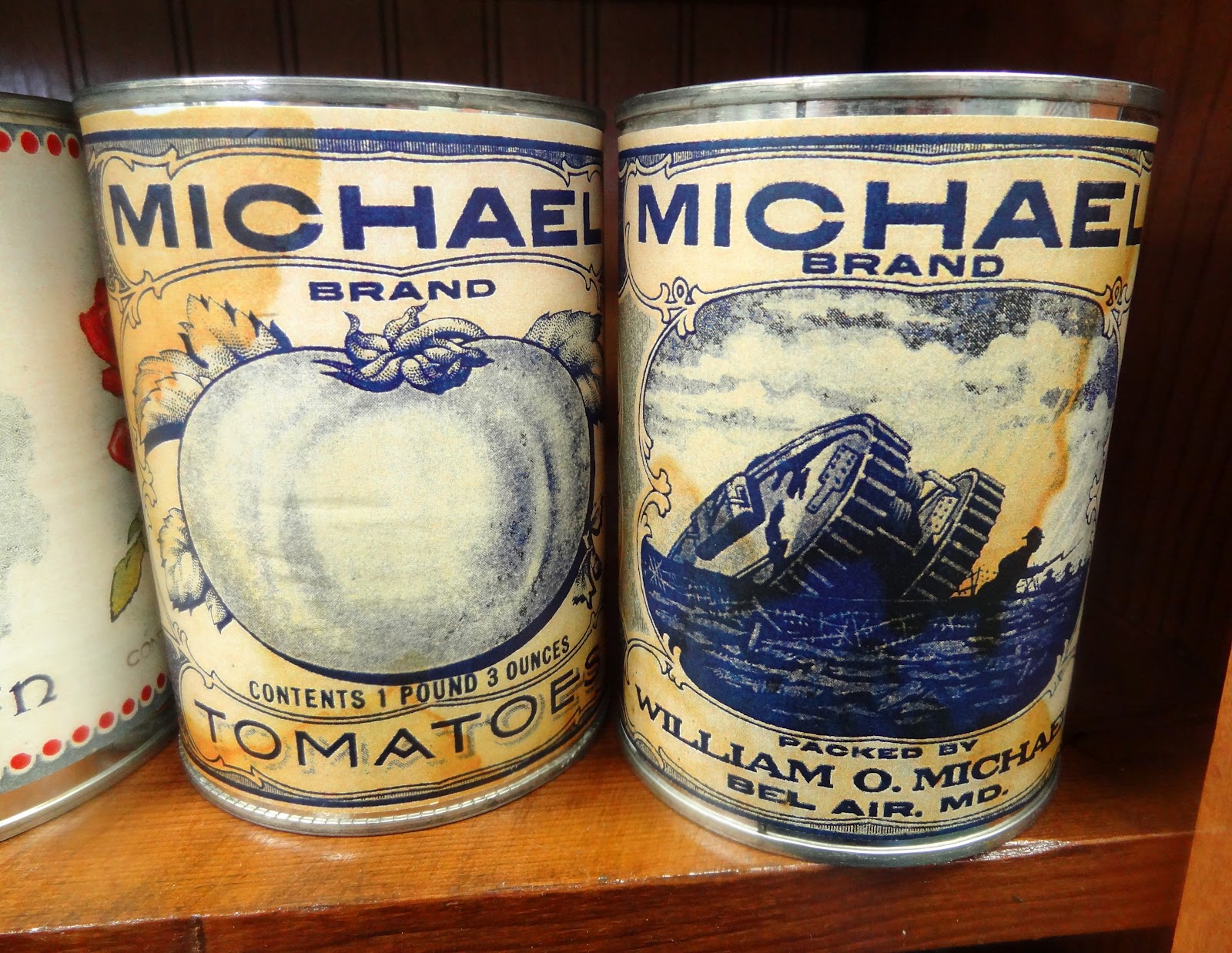
Look at a few of them below to see why I was so fascinated. Notice that two of the cans have plainer labels with a tank and warships on them. These were manufactured during wartime. Also, be sure to read all of the label on the Real Value can. I don't think you will see anything like that in our stores today.

Note: Most cans are paired with a front and back picture of the label.
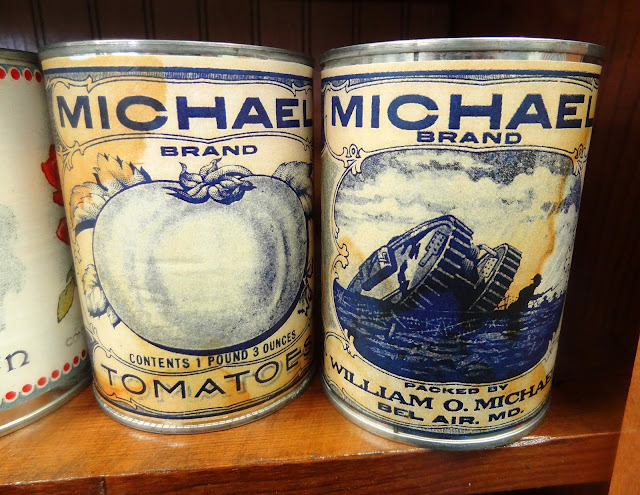


Notice the tank on the back of this can. This is from WWII days.


Also, manufactured during WWII, notice the colorless label with the patriotic war theme.


I think this is what you call real truth in advertising.


You can tell there were cooked oysters in these cans because they have labels on them. Most oysters were not cooked and were shipped in cans on ice where the label would not survive.

__________________________________________________________________________________

But Wait, There's More:
While Ward and Wally appreciated all of the labels, here's what they found most interesting.
Ward:
Early in the 20th century, canning was the primary method of preservation of food. Given the short time frame for harvest season, it was important to get crops to the canneries as fast as possible. Before transportation was cheap, fast and reliable, canneries were located nearly everywhere. Most towns of any size had a cannery, and many had two or four or even a dozen. Nowadays, we see many fewer, much larger canneries. Progress, I guess.

Wally:
Did you know that before 1906 weights didn't have to be put on the labels? Also, cans used to be made from three parts--a top, a bottom, and a cylinder. Not two parts like today. (Ward and I were not as interested in this. We are old enough to remember seeing three part cans.)