Sunday, April 21, 2019

Thankful Sunday, April 21, 2019


I am thankful for Easter because it reminds us that all things are possible.


Saturday, April 20, 2019

R is for Rules

#AtoZChallenge 2019 Tenth Anniversary blogging from A to Z challenge letter RThere are rules for just about everything. Some are important for safety. "Don't touch the high voltage wire." Some are important for order. "Please wait for the next available agent." And some don't make sense. "Don't wear your hat inside."


I was having a discussion with a co-worker about this nonsensical rule the other day.  One of our coworkers was wearing a hat inside and my friend was appalled because she considered that to be rude. I said that was the rule that I grew up with, but I thought it was relaxing a bit, especially with billed hats. I had seen a lot more people wearing a billed hat inside without much notice.  Well, apparently I'm wrong because according to  Levine Hats and also, the Emily Post Institute, it's still not okay for a man to wear a hat inside unless it's indicated for religious reasons. Actually there are a lot more rules about hat wearing than I realized. You can see them at the end of the post.

How did that rule ever get started in the first place? Once again, Emily Post gives some insight to this question. She said that knights would lift their visor or remove their helmet to show that they were friendly. Failure to do so could result in battle. It's hard for me to believe that a practice from over five centuries ago is still influencing what we wear on our head, but I read it on the internet so it must be true.

Also according to the Emily Post Institute here are the rules for hat wearing. See how many you follow. It looks like I follow most all of them.

Men
Hats can be left on…
  • Outdoors
  • At athletic events (indoors or out)
  • On public transportation
  • In public buildings such as post offices, airports,  and hotel or office lobbies
  • On elevators

Take hats off, including baseball caps …

  • In someone’s home
  • At mealtimes, at the table
  • While being introduced, indoors or out (unless it’s frigid!)
  • In a house of worship, unless a hat or head covering is required
  • Indoors at work, especially in an office (unless required for the job)
  • In public buildings such as a school, library, courthouse, or town hall
  • In restaurants and coffee shops
  • At a movie or any indoor performance
  • When the national anthem is played
  • When the flag of the United States passes by, as in a parade

Women

Fashion hats (not baseball-style caps) can be left on…


  • In someone’s home
  • At luncheons, weddings, garden parties
  • At religious services
  • At a movie or any indoor performance
  • When the national anthem is played
  • When the flag of the United States passes by, as in a parade

Take your fashion hat off…

  • Anytime it blocks someone’s view, such as at a wedding or in a theater
  • Indoors at work

Remove baseball-style (unisex) caps…

  • In someone’s home
  • At mealtimes, at the table
  • While being introduced
  • In a house of worship, unless a hat or head covering is required
  • Indoors at work, unless required for the job
  • In public buildings such as a school, library, courthouse, or town hall
  • In restaurants and coffee shops
  • At a movie or any indoor performance
  • When the national anthem is played
  • When the flag of the United States passes by, as in a parade

Cancer patients are exempt from hat rules. They may keep their hats or caps on at all times if they wish


Friday, April 19, 2019

Q is for Quack

or A  Duck's Quack doesn't echo and no one knows why?
or Does it?

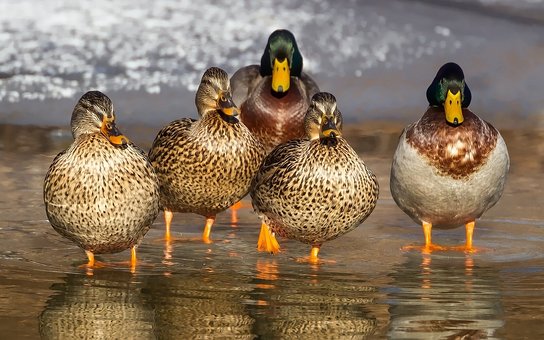
Duck, Wild, Mallard, Animals, Feathers

I was brainstorming with Miss Landers for a topic for the Q post and she suggested the Q is for Quack theme. She said I could talk about why a duck's quack doesn't echo--something about the reverberation chamber in a duck's head. Wow. That was interesting and something I had never heard of. I had a topic, "Why does a duck's quack not echo?" Now for a little research.

It turns out that I was not able to figure out why a duck's quack doesn't echo because it can under the right circumstances. An acoustics professor from University of Salford in England did the most quoted study proving that the quack statement was indeed quackery. Snopes reported on the falsehood in 1999 and MythBusters did a experiment in 2003 that busted the myth.

Now the interesting part is no one is quite sure where the myth came from or why it was proposed. But it has certainly propagated over the years. There was even a British game show on from 2014-2017 with that name. Have you heard about the echo-less quack before? Did you think it was true? If you did, did you have an explanation for it?

Another day of Live and Learn for me.


Thursday, April 18, 2019

P is for Plants and Pets

Plants and pets, two things that don't mix well. At least from my experience. I have had six cats during my adult life and all of them have loved to nibble on plants. Nibble, nibble. Throw up. Repeat.

I thought maybe when they were kittens, they would grow out of it, but they didn't. When I tried to grow seedlings for the garden, they would eat them. After we put the seedlings behind netting, they would dig at the netting until they could get at the seedlings and eat them. I finally told Ward to not buy me any more flowers because of the battle with the cats. It seemed no matter where we put the the flowers, the cats would somehow manage to get them and do the nibble, nibble, throw up routine. It became evident pretty fast, we needed to be very careful that we didn't have any plants that could be harmful to them because they couldn't leave them alone.  We tried growing grass for them to eat several times to no avail. That they would pull up by the roots and then string dirt around the house.


We finally started to put our plants potted and otherwise behind closed doors--usually in an extra bedroom. Then it became our problem with out-of-sight, out-of-mind and we let more than one plant die that way.

Christmas cactus before cats
As time went on and we decreased our number of cats from four to three, things seemed a little better. That's why I agreed to take a very large Christmas cactus that Ward's father was giving away. It was nontoxic to cats, so why not? The first week in residence, the cactus was left alone. Then I started to notice bite marks in the leaves. Later I noticed pieces of it laying here and there. Soon it was necessary to also banish this plant to the extra bedroom behind closed doors if there was going to be any chance for it to survive. However, anytime the door was accidentally left open, we would find more pieces and parts around the house.
Cactus after cats

We are slow learners, but we finally realized that this was a battle we weren't going to win. Then I had an idea. I would have a terrarium with a secure lid for my bit of inside greenery. And guess what? It worked. I finally have a little green growing in a place I can see every day. No more nibble, nibble,... And all is right with the world.

Terrarium before cats (Lid removed for photo.)

P
is for a Perfect solution to my Pets and Plants Problem. 


Terrarium after cats. (Lid removed for photo.)

Wednesday, April 17, 2019

O is for Onomatopoeia

#AtoZChallenge 2019 Tenth Anniversary blogging from A to Z challenge letterDo you have any words that you just like the sound of? That you find fun to say? Onomatopoeia is one of those words for me. Maybe it's all the vowel sounds or the way it trips along off the tongue with those short syllables. Or maybe I just like the concept of what onomatopoeia represents--a word that is defined by the sound it makes, such as thud, cluck, or woof.

What's interesting is the sounds for different things are different in different languages. It we hear a bell clang, whether it is here, in Japan, or Germany, theoretically all of our words for that sound should be the same or at least similar. But it doesn't usually work out that way. For example, here are a few examples of what a dog says in different languages:

US--ruff-ruff, woof-woof, arf-arf, or for a little dog--yip-yip, yap-yap.
Albanian--ham-ham
Burmese--woke-woke
Hindi--bow-bow
Lebanese--haw-haw
Polish--hau-hau

So there's quite a variety in just those few examples, and we can't even agree on the sound in our own language. But do you see the one thing they have in common? The dog always barks twice.

Onomatopoeia is also a device that can be used quite effectively in literature, especially poetry. I think no one did this better than Edgar Allan Poe. So in honor of National Poetry Month, here is his most famous poem using onomatopoeia.

The Bells       
Hear the sledges with the bells-
                  Silver bells!
  What a world of merriment their melody foretells!
          How they tinkle, tinkle, tinkle,
              In the icy air of night!
          While the stars that oversprinkle
          All the heavens, seem to twinkle
            With a crystalline delight;
                Keeping time, time, time,
            In a sort of Runic rhyme,
  To the tintinnabulation that so musically wells
            From the bells, bells, bells, bells,
                  Bells, bells, bells-
  From the jingling and the tinkling of the bells.

                        II

          Hear the mellow wedding bells,
                  Golden bells!
  What a world of happiness their harmony foretells!
          Through the balmy air of night
          How they ring out their delight!
            From the molten-golden notes,
                  And an in tune,
            What a liquid ditty floats
  To the turtle-dove that listens, while she gloats
                  On the moon!
          Oh, from out the sounding cells,
  What a gush of euphony voluminously wells!
                  How it swells!
                  How it dwells
            On the Future! how it tells
            Of the rapture that impels
          To the swinging and the ringing
            Of the bells, bells, bells,
          Of the bells, bells, bells,bells,
                  Bells, bells, bells-
  To the rhyming and the chiming of the bells!

                        III

          Hear the loud alarum bells-
                  Brazen bells!
  What a tale of terror, now, their turbulency tells!
          In the startled ear of night
        How they scream out their affright!
          Too much horrified to speak,
          They can only shriek, shriek,
                  Out of tune,
  In a clamorous appealing to the mercy of the fire,
  In a mad expostulation with the deaf and frantic fire,
          Leaping higher, higher, higher,
            With a desperate desire,
          And a resolute endeavor,
          Now- now to sit or never,
        By the side of the pale-faced moon.
          Oh, the bells, bells, bells!
          What a tale their terror tells
                  Of Despair!
        How they clang, and clash, and roar!
        What a horror they outpour
      On the bosom of the palpitating air!
          Yet the ear it fully knows,
                  By the twanging,
                  And the clanging,
          How the danger ebbs and flows:
          Yet the ear distinctly tells,
                  In the jangling,
                  And the wrangling,
          How the danger sinks and swells,
  By the sinking or the swelling in the anger of the bells-
                  Of the bells-
          Of the bells, bells, bells,bells,
                Bells, bells, bells-
      In the clamor and the clangor of the bells!

                        IV

          Hear the tolling of the bells-
                  Iron Bells!
  What a world of solemn thought their monody compels!
          In the silence of the night,
          How we shiver with affright
    At the melancholy menace of their tone!
          For every sound that floats
          From the rust within their throats
                    Is a groan.
          And the people- ah, the people-
          They that dwell up in the steeple,
                  All Alone
          And who, tolling, tolling, tolling,
            In that muffled monotone,
          Feel a glory in so rolling
            On the human heart a stone-
          They are neither man nor woman-
          They are neither brute nor human-
                  They are Ghouls:
            And their king it is who tolls;
            And he rolls, rolls, rolls,
                  Rolls
              A paean from the bells!
          And his merry bosom swells
            With the paean of the bells!
          And he dances, and he yells;
          Keeping time, time, time,
          In a sort of Runic rhyme,
            To the paean of the bells-
                  Of the bells:
          Keeping time, time, time,
          In a sort of Runic rhyme,
            To the throbbing of the bells-
          Of the bells, bells, bells-
            To the sobbing of the bells;
          Keeping time, time, time,
            As he knells, knells, knells,
          In a happy Runic rhyme,
            To the rolling of the bells-
          Of the bells, bells, bells:
            To the tolling of the bells,
          Of the bells, bells, bells, bells-
            Bells, bells, bells-
    To the moaning and the groaning of the bells.